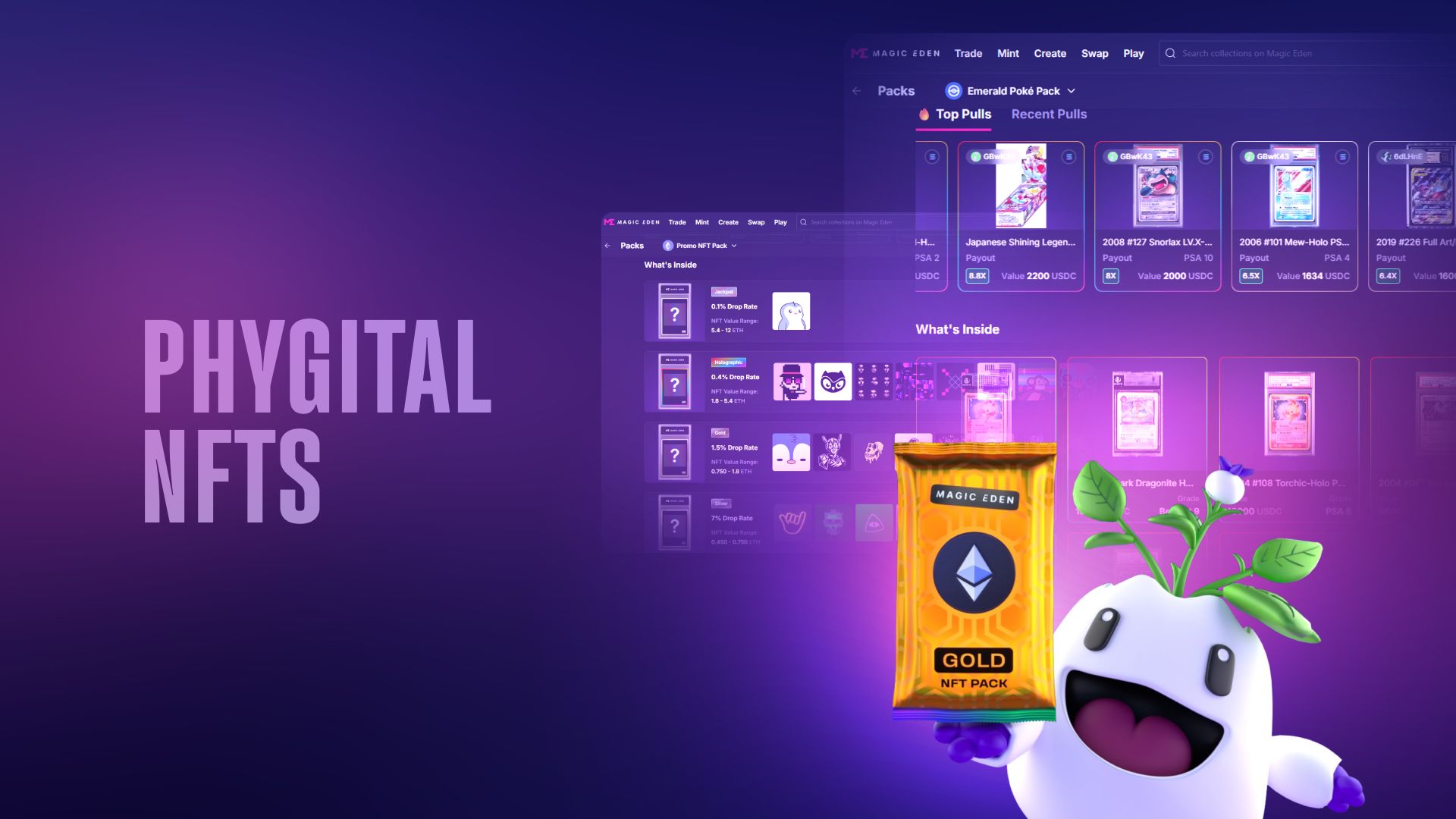
Phygitals are one of the most exciting trends in Web3 right now. They blend physical collectibles with digital ownership, letting you hold something that's real while proving it's yours onchain.
In this guide, we’ll explore what phygital NFTs are, how they work, why there’s so much buzz around them, and where they’re already showing up in the real world.
Phygital NFTs are a specific type of non-fungible token that have both a digital and physical component (hence the term ‘phygital’).
From gaming to fashion, these NFTs are popular across multiple industries, helping to link physical and digital worlds. Brands are using them to boost brand visibility and attract and engage community members.
A prime example of phygital NFTs is tokenized Pokémon trading cards, which combine the physical card with an NFT representing it to create a hybrid ‘phygital’ Pokémon card collectible.
Unlike other digital assets, many phygital NFT items can be bought both online or in person, making the experience very accessible. It’s much easier for those new to Web3 to comprehend the advantages of the digital NFT when it has a physical item or experience tied to it.
This accessibility is helping phygitals gain traction among newcomers, which is opening doors for brands to engage audiences through customer loyalty programs and customized experiences.
It’s also increasingly important for consumers to be able to trust what theye buying. These days, convincing fakes are everywhere. Phygital NFTs, which benefit from blockchain’s immutability, are great for customers who want to make sure they’re buying an authentic and verifiable product or experience.
Specific segments of the phygital market are also growing particularly quickly. One report on the phygital sports sector, for instance, shows the sector jumped from being valued at $1.67 billion in 2024 to $2.12 billion in 2025, and is predicted to reach $5.54 billion in 2029, thanks to the growing popularity of immersive fan experiences, wearable tech, and blockchain-backed collectibles.
Phygital trading cards like Pokémon cards are also booming, as more people get hooked on the thrill of pulling rare cards both online and in person. The entire NFT trading cards market is expected to reach US $10.5 billion by 2033, with a CAGR of around 24.5%.
At their core, phygital NFTs use blockchain tech to create a secure, verifiable link between a physical asset and its digital counterpart. This enables features like authenticity checks and easy transfers.
Phygital NFTs combine a real item you can hold with a digital version you can show off onchain. Each one is recorded onchain, making it easy to prove ownership or transfer it to someone else.
Owners of phygital NFTs can showcase their physical items at home, in a gallery or at an exhibition, while at the same time displaying them online through virtual galleries, interactive displays or augmented reality experiences.
Like all the other types of NFTs, phygital items are powered by smart contracts. This makes them immutable and tamper-resistant. Aside from guaranteeing authenticity, blockchain technology prevents counterfeits of phygital NFTs.
The blockchain makes it easy to track a phygital NFT’s ownership path and manage distribution. This helps avoid disputes and makes buying, selling, or redeeming a real-world item much smoother.
Plus, smart contracts do all the heavy lifting behind the scenes. They even allow fractional ownership, so a few people can share a stake in one rare collectible.
Now, let’s take a look at five standout phygital NFT use cases across different sectors.
Some of the most popular phygital trading cards and collectibles include the Pokémon trading card NFT packs recently released by Magic Eden in partnership with Collector Crypt. These also allow you to redeem the physical trading card that each NFT represents.
Phygital NFTs are big business in fashion and luxury items. Notable examples include this phygital ring by designer Francine Ballard of Metagolden. It was auctioned off in Sotheby’s NY ‘Art as Jewelry as Art’ sale and the buyer of the gold-and-emerald ring now owns it both IRL and on chain.
In fashion, the likes of Gucci and Louis Vuitton are all experimenting with phygital NFTs, tying them to exclusive physical items and digital experiences.
Artists can also use phygitals to offer limited-edition prints, sculptures or custom pieces, where the NFT serves as a certificate of authenticity. NFT artist FVCKRENDER, for example, enlisted the help of creative marketplace Avant Arte to release two phygital sculptures called FEEL// and TOUCHED//.
NFT-enabled ownership upgrades can upgrade gaming and experiences through concepts like the Claynosaurz plushies.
Then there are also Proof of Attendance Protocol (POAP) tokens attendees receive at in-person and online events like concerts, meetups and conferences. One such occasion was an immersive experience at SXSW 2022 offered to Doodles NFT holders.
Brands and businesses can launch phygital NFTs as ways to authenticate items or offer exclusive digital content linked to physical products or experiences. Beverage brand Whiskey Barrel, for example, provides a digital certificate of authenticity as an NFT with its limited-edition drink.
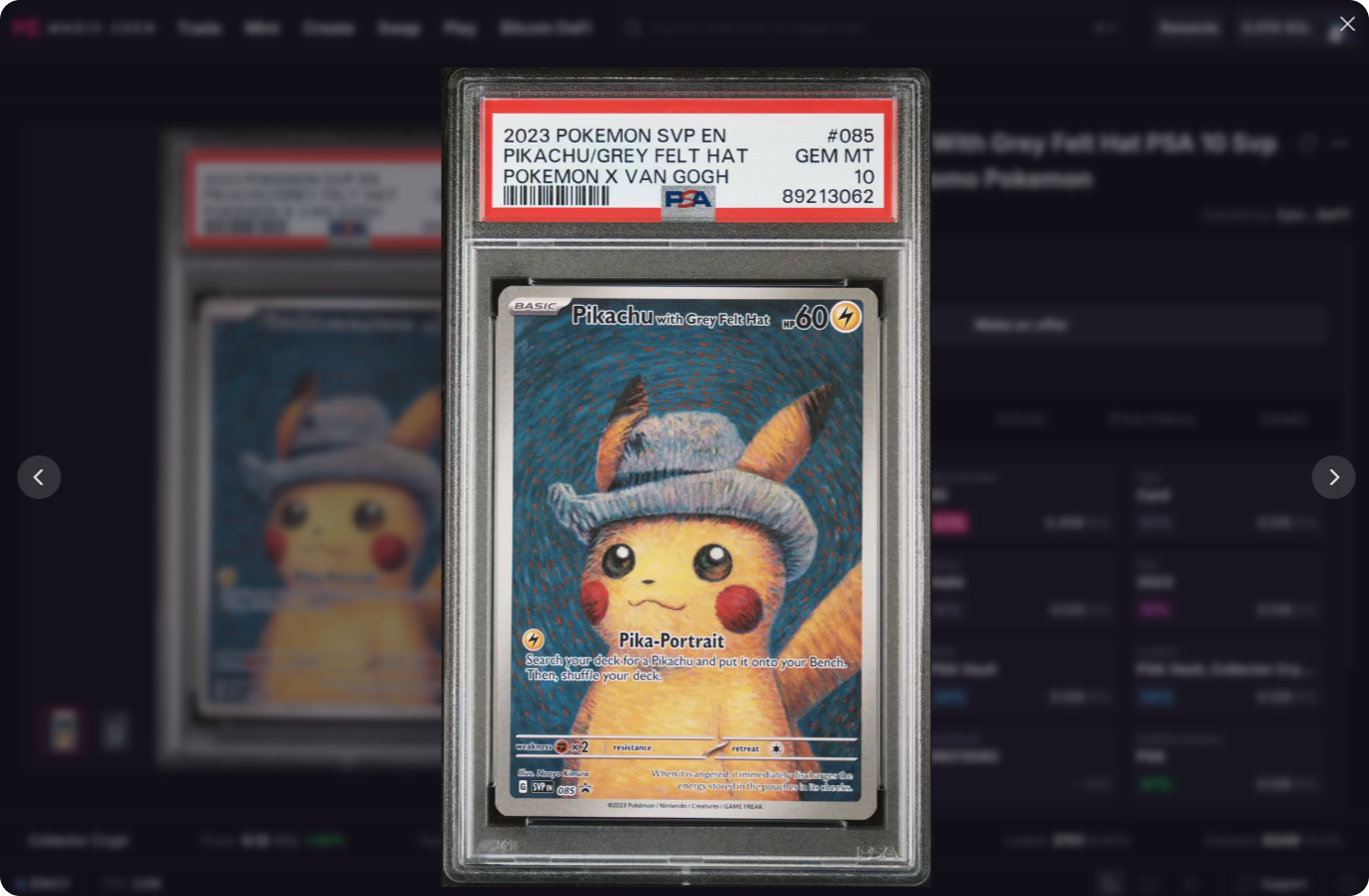
Pokémon card NFTs are one of the biggest phygital trends right now.
The lifecycle of a Pokémon card, from physical collectible to phygital NFT, is a great example of how the blockchain can turn traditional cards into secure, tradeable digital assets.
On Magic Eden, you can become part of the growing phygital NFT holder community and collect tokenized Pokémon cards backed by real, graded physical assets. Check out new packs, explore drops, reveal your pulls instantly and trade with other collectors on the marketplace.
Connect your wallet and start opening Pokémon NFT Packs on Magic Eden.
On Magic Eden, you can redeem your Pokémon phygital NFT for the physical card by clicking ‘Redeem’ in the Pack results interface or from your Activity page. Then, you’ll need to sign in on Collector Crypt’s website with the same wallet containing your tokenized Pokémon card. From there, you can choose the card, click to see more options, then select ‘Remove from marketplace’ and check out.
Absolutely. You can trade Pokémon phygitals on NFT marketplaces like Magic Eden. There, you can purchase, open, sell and trade your Pokémon phygital NFTs or even redeem them for their real-life physical equivalents.
To sell your phygital NFTs, you’ll first need to ship the physical part of your phygital to a dedicated third-party vaulting and tokenization service. Upon receipt and verification, the item is placed in secure storage. The next step involves minting the corresponding NFT, which is then delivered to the rightful owner’s account. These tokens can then be traded on NFT platforms such as Magic Eden. When someone buys your phygital NFT, they’re entitled to both the digital and corresponding physical item.
The information provided on this website is provided for general educational purposes only and is in no way financial or investment advice. Certain information may have also been provided to us or prepared by third parties; these materials are provided for convenience and are not an endorsement by Magic Eden. Magic Eden is not liable for any errors, changes or amendments to such information, including any actions taken in reliance on such information.